



New Delhi, Aug. 21: The Centre has approved a major railway infrastructure project worth ₹9,450 crore aimed at adding around 410 km of new rail capacity across West Bengal, Odisha, Andhra Pradesh and Tamil Nadu.
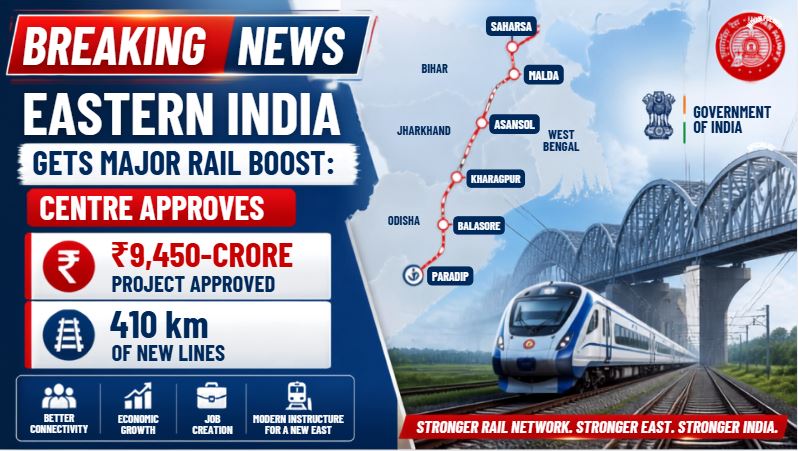
Representational Image
The expansion is expected to ease congestion on some of eastern India’s busiest railway corridors, improve passenger connectivity and accelerate the movement of freight between ports, industrial centres and inland markets.
The project is expected to benefit nearly 60 lakh people across 6,448 villages, while strengthening rail infrastructure in regions with significant industrial, mining and port activity.
Four key railway corridors to get additional capacity
The approved works cover four important sections:
Kharagpur–Bhadrak: 173 km fourth line
Bhadrak–Haridaspur: 75 km fourth line
Gummidipundi–Gudur: 90 km third and fourth lines
Cuttack–Paradeep: 72 km third and fourth lines
Together, the projects will add approximately 410 km of additional railway capacity to the network.
Odisha to gain significantly
Several important railway hubs in Odisha and neighbouring states are expected to benefit from the expansion, including Bhadrak, Cuttack, Paradeep, Haridaspur and Kharagpur, along with the Gudur corridor in Andhra Pradesh.
The Cuttack–Paradeep and Kharagpur–Bhadrak sections are particularly important for Odisha’s freight network, given their links with major industrial zones and ports. Increased rail capacity is expected to facilitate smoother movement of cargo to and from ports such as Paradeep and Dhamra.
Freight movement likely to become faster
One of the biggest advantages of the project will be increased capacity for freight trains carrying coal, iron ore, steel, cement, foodgrains, containers and automobiles.
With additional lines, freight trains will have greater operational flexibility, potentially reducing waiting time and congestion while improving the movement of raw materials to industries and finished goods to domestic and export markets.
Connectivity and economic activity
The railway expansion is also expected to generate wider economic benefits by improving access to markets, supporting industrial growth and creating opportunities for local businesses and employment.
For passengers, additional track capacity could help improve train operations and reduce delays on heavily utilised routes where passenger and freight services currently compete for limited track space.
Projects targeted for completion by 2030-31
Following the Centre’s approval, the projects will move towards implementation, including construction and tendering activities. The government has set a target of completing the works by 2030-31.
The ₹9,450-crore investment is expected to significantly strengthen eastern India’s rail network and improve the region’s role as a key corridor for passenger travel, industrial development and national freight movement.
