



New Delhi, Oct 27: India has taken a significant step towards expanding the use of ethanol-based fuels, with the Ministry of Road Transport and Highways (MoRTH) amending the Central Motor Vehicles Rules, 1989, to include E100 fuel in the regulatory framework for compatible flex-fuel vehicles.
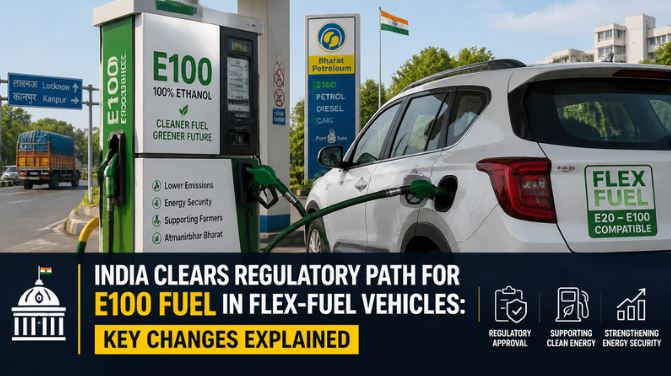
Representational Image
The amendment, notified through GSR 911(E) dated October 23, 2026, updates existing emission-related provisions to recognise vehicles designed to operate on E100, a fuel comprising 100 per cent ethanol. The move establishes a regulatory basis for vehicles capable of running on nearly pure ethanol, although it does not announce a nationwide rollout of E100 at petrol pumps.
What Is E100 Fuel?
E100 is an ethanol-based fuel containing 100 per cent ethanol, while E85 contains approximately 85 per cent ethanol. Ethanol can be produced from agricultural feedstocks such as sugarcane and other biomass sources.
Until this amendment, the relevant emission-rule references for flex-fuel vehicles primarily mentioned E85. The revised provisions explicitly add E100 alongside E85, creating a clearer regulatory framework for vehicles engineered to use higher concentrations of ethanol.
Flex-fuel vehicles are designed to operate on different proportions of petrol and ethanol, depending on their engineering specifications and certification.
E100 Is Not for Every Petrol Vehicle
One of the most important aspects of the new rules is the restriction on vehicle compatibility.
According to the notification, E85 and E100 are intended for vehicles designed by original equipment manufacturers (OEMs) as flex-fuel vehicles.
This means conventional petrol cars and motorcycles cannot automatically use E100. Even vehicles compatible with E20 petrol should not be filled with E100 unless the manufacturer has specifically approved the vehicle for that fuel.
Using an incompatible fuel can damage engine and fuel-system components. Vehicle owners should follow the manufacturer’s fuel specifications and safety guidance.
Key Changes to the Central Motor Vehicles Rules
The amendment introduces several technical updates to the existing regulatory framework.
1. E100 added to emission provisions: References to E85 in relevant sections of Rule 115 have been updated to read “E85 or E100”, extending the provisions to vehicles designed for both fuel types.
2. Revised vehicle weight threshold: The gross vehicle weight threshold in the relevant emission-standards table has been increased from 3,000 kg to 3,500 kg.
3. Updated technical reference: Rule 115E now refers to Annexure SA instead of Annexure S for E100 vehicles, as specified in the notification.
4. Biodiesel reference revised: A fuel entry in the relevant table has been changed from B10 to B100.
The notification also includes technical and editorial corrections to certain fuel classifications, emission-table headings, measurement units and related provisions.
How Were the New Rules Finalised?
The government had published the draft amendment in the Gazette of India on April 27, 2026, inviting objections and suggestions from stakeholders within the prescribed 30-day period.
Following consideration of the feedback received, the ministry issued the final notification on October 23, 2026. The rules take effect from the date of publication in the Official Gazette, as stated in the notification.
Will E100 Be Available at Petrol Pumps Soon?
Despite the regulatory approval, the notification does not specify a nationwide launch date for E100 fuel or confirm widespread availability at retail fuel stations.
The amendment primarily establishes the regulatory provisions for E100-compatible flex-fuel vehicles. Wider adoption will depend on factors such as vehicle development, certification, fuel production, distribution infrastructure and commercial availability.
For automobile manufacturers, the revised framework offers a clearer basis for developing and certifying vehicles capable of using high-ethanol fuels. For consumers, however, the practical benefits will depend on the availability of compatible vehicles and fuel stations.
What Does This Mean for India’s Fuel Future?
The move supports India’s broader efforts to diversify its energy mix, promote domestic biofuel production and reduce dependence on imported crude oil.
Greater use of ethanol could also create opportunities for agricultural producers and biofuel manufacturers. However, the overall economic and environmental benefits will depend on production methods, fuel pricing, vehicle efficiency and the sustainability of feedstock supplies.
For now, the E100 amendment represents a regulatory step towards expanding India’s alternative-fuel options rather than an immediate replacement for conventional petrol.
The bottom line: E100 has received a place in India’s regulatory framework for compatible flex-fuel vehicles, but ordinary petrol vehicles cannot automatically use it, and nationwide availability has not yet been announced.
