



New Delhi, Nov 21: Women entrepreneurs account for nearly 38% of India’s registered MSME ecosystem, highlighting their growing role in the country’s economic development. The government is now looking to build on this momentum by improving access to finance, technology, markets and international business opportunities for women-led enterprises.
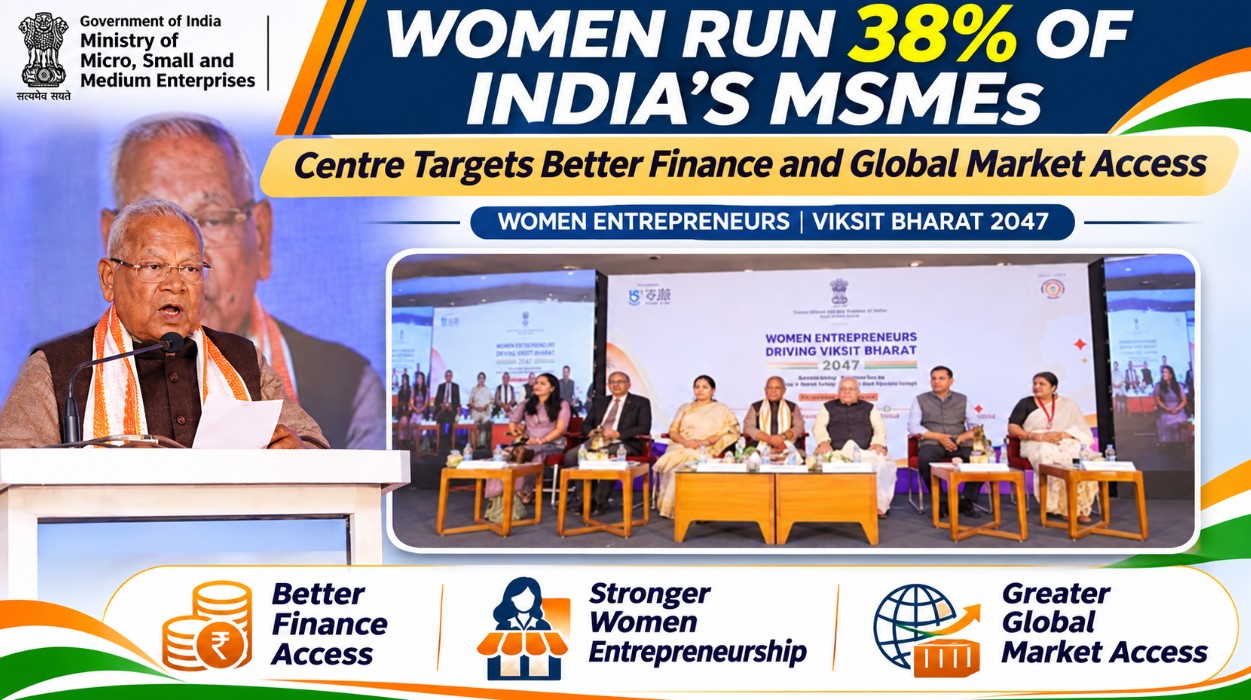
The focus was at the centre of the Women Entrepreneurship Day 2026 celebrations organised by the Ministry of Micro, Small and Medium Enterprises in partnership with the India SME Forum in New Delhi on November 19.
The conference brought together policymakers, financial institutions, industry representatives, development organisations and women business owners to discuss ways to help women move from starting small enterprises to building competitive and scalable businesses.
The discussions were structured around four priorities — Enable, Accelerate, Digitise and Globalise — reflecting the need to strengthen support for women at every stage of entrepreneurship.
Women-Owned Businesses Take a Larger Role in MSME Sector
Union MSME Minister Jitan Ram Manjhi, who attended as the chief guest, highlighted the contribution of women to families, communities and the wider economy.
He said nearly 38% of MSMEs were women-led and emphasised the importance of government schemes, international partnerships and policy reforms in expanding opportunities for women entrepreneurs.
Manjhi also referred to amendments to the MSME Development Act, 2026, and the role of the Trade Receivables Discounting System (TReDS) in improving payment access and addressing delays in payments to small businesses.
Secretary of the MSME Ministry Bharat Khera said women-owned enterprises account for approximately 38% of the more than 10 crore enterprises registered with the Ministry. He stressed that the next stage of development must go beyond formal registration and help women-led businesses become stronger market players.
He called for better access to global markets, equity investment and wider integration into domestic and international value chains.
Government Schemes Expand Women’s Economic Participation
Minister of State for MSME and Labour and Employment Shobha Karandlaje said financial independence was essential for women to emerge as leaders in business and society.
She pointed to the growing financial credibility of women entrepreneurs and said the Reserve Bank of India’s recognition of women-led self-help groups as reliable borrowers reflected increasing confidence in their financial capabilities.
Karandlaje also highlighted the contribution of government programmes, stating that the Prime Minister’s Employment Generation Programme (PMEGP) had supported the creation of more than 25 lakh jobs for women.
She further noted that public procurement from women-owned micro and small enterprises had crossed the mandatory 3% target, indicating growing participation in government purchasing.
From Local Skills to Global Markets
Kalraj Mishra, former Governor of Rajasthan and Himachal Pradesh and Chief Patron of the India SME Forum, called for transforming women from job seekers into job creators.
Referring to initiatives such as Lakhpati Didi, he emphasised the need to connect grassroots skills and local production capabilities with larger markets. Digitalisation, access to growth capital and institutional support, he said, could help women-led businesses become part of global value chains.
Additional Secretary and Development Commissioner of the MSME Ministry, Dr Rajneesh, described women entrepreneurs as an important contributor to India’s economic growth. He said rising female labour force participation, improved access to credit and opportunities emerging from India’s free trade agreements were creating new possibilities for women-led enterprises.
Four Priorities to Strengthen Women-Led Enterprises
The conference featured four technical sessions designed to address the challenges faced by women entrepreneurs at different stages of business development.
Enable – From Aspiration to Enterprise: Focused on helping aspiring women entrepreneurs establish businesses through better access to support systems and institutional resources.
Accelerate – From Survival to Scale: Examined ways to help existing enterprises expand operations, improve competitiveness and achieve sustainable growth.
Digitise – Empowering Women through Digitalisation: Explored how digital tools and technology can improve business efficiency and widen market access.
Globalise – From Local to Global: Discussed ways to connect women-led enterprises with international trade opportunities and global supply chains.
Representatives from several government departments and institutions, including the Ministries of Rural Development and Electronics and Information Technology, Government e-Marketplace (GeM) and SIDBI, participated in the discussions.
State Rural Livelihood Missions from Andhra Pradesh, Bihar and Jammu and Kashmir were also represented, alongside organisations such as UN Women, the Gates Foundation, Digital Empowerment Foundation and Vedanta’s CSR arm.
Focus Shifts from Enterprise Creation to Business Growth
The discussions highlighted a broader shift in India’s approach to women’s entrepreneurship. While access to registration, training and initial financial support remains important, the next challenge is to help women-owned businesses expand, compete and secure a stronger position in the marketplace.
The Ministry of MSME said it would continue working to improve women’s access to finance, skills, technology, procurement opportunities and international markets.
With women already accounting for a significant share of registered MSMEs, strengthening their ability to scale up could have wider implications for employment generation, economic participation and India’s ambition of becoming a developed nation by 2047.
