
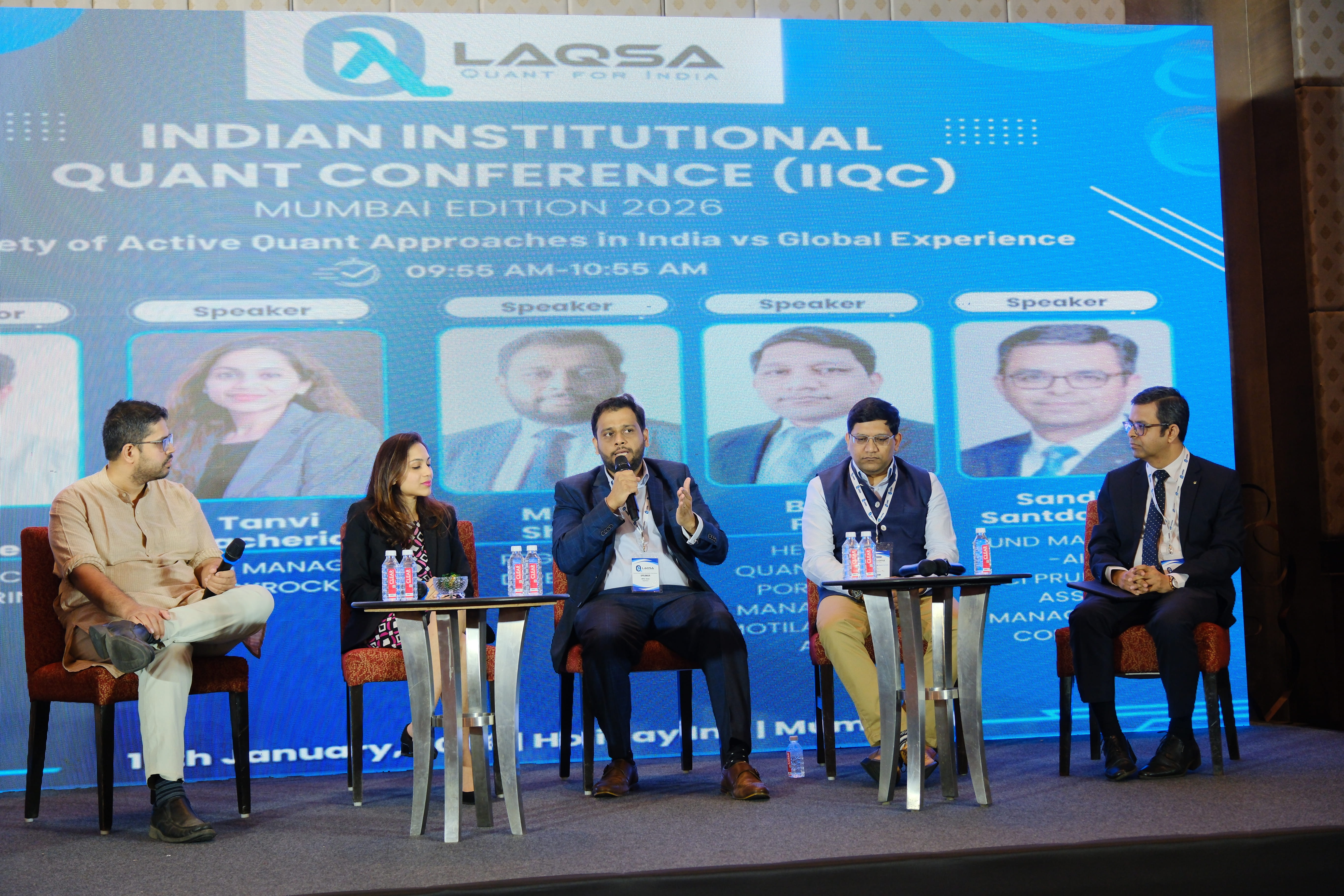
Mumbai, January 19, 2026: The financial capital played host to a convergence of global intellect and domestic institutional power as the Lambda Quantitative Strategies Association (LAQSA) successfully concluded the 4th edition of the Indian Institutional Quant Conference (IIQC) on January 16 at the Holiday Inn hotel here in the city’s suburbs. Marking the second time the prestigious event has taken place in Mumbai, the conference underscored the rapid maturity of the Indian ecosystem regarding quantitative strategies.
Various top research institutions and market-education bodies like Nuvama Asset Services, BSE, Nubra, LSEG, FACTSET, ICICI Prudential Asset Management Company and many more supported the event through sponsorships, with Nuvama returning as the title sponsor.
With a meticulously curated agenda, the day-long event featured high-impact panels, fireside chats and technical presentations, bringing together leaders from Asset Management Companies (AMCs), Family Offices, Global Research firms, and academia.
The event kicked off with a welcome address by LAQSA stalwarts Rishi Kohli (JioBlackRock AMC), Pankaj Mani (RealWorldRisk, Research Author at World’s Prestigious Wilmott Quant Magazine), and Pawan Mehar (Unicorn), setting the stage for a day dedicated to rigorous data-driven debate.
A key session of the conference focused on the importance of research for India’s quant community and the economy at large, bringing together perspectives from academia, policy, and practice. Featuring Dr. Nishith Desai, Founder of Nishith Desai Associates, and Prof. Chintan Vaishnav (MIT; former Mission Director, Atal Innovation Mission (AIM), NITI Aayog, Government of India), the discussion emphasised how rigorous, reproducible research strengthens the foundations of quantitative finance—by improving decision frameworks, sharpening risk thinking, and enabling institutions to build long-term capabilities. The speakers also underscored that a deeper research culture in India can extend beyond markets, supporting innovation, productivity, and durable economic development.
Other notable panellists include Tanvi Kacheria – Fund Manager at JioBlackRock, Sunil Ramrakhiani – Chief Business Officer at BSE, Rajesh Bhatia – Chief Investment Officer at ITI Mutual Fund, Sandip Santdasani – Fund Manager (AIF) at ICICI Prudential Asset Management Company and Prof. Espen Haug – World-Renowned Quant, Physicist, International Best-Selling Author.
Another key highlight of the mid-day session was a critical examination of the intellectual foundations of modern research. Through a fireside chat and presentation on the “Replication Crisis,” LAQSA Co-Founder Pankaj Mani, along with Balakrishnan Ilango (LSEG), discussed why a large proportion of published research findings may be statistically unreliable. The conversation called for a renewed commitment to scientific rigour across disciplines, including economics and finance, medical sciences, social sciences, psychology, hard sciences such as physics, and even policymaking.
The discussion was grounded in Pankaj Mani’s recently published global paper, “Replication Crisis: Why Science Needs to Be More Scientific,” featured in the world’s prestigious Wilmott Quant Magazine, which was written as a response to Stanford professor John Ioannidis’s influential 2005 paper, “Why Most Published Research Findings Are False.”
The post-lunch agenda bridged the gap between theory and capital allocation. A dedicated panel featuring representatives from Maheshwari Investors, Julius Baer, and Famy Care explored “How Family Offices Use Quant Strategies,” highlighting the growing appetite among ultra-high-net-worth individuals for systematic internal and external allocations.
The technical depth of the conference reached its peak with sessions led by world-renowned physicist and options trader, Prof. Espen Haug, who presented on “Option Strategies, Fat-Tails & Monetary Policy.”
Pankaj Mani, Co-Founder, LAQSA, said about the event, “IIQC Mumbai Edition reflected how quickly India’s institutional quant conversation is moving—from strategy design to implementation, and from ‘best practices’ to world-class research rigor. The sessions on replication, long–short readiness and fat-tail risk sparked exactly the kind of candid dialogue we want to build across the ecosystem for the social and economic awareness across the country.”
Rishi Kohli, Co-Founder, LAQSA, added wrapping-up the event “Bringing IIQC back to Mumbai for the second time was important for us, because the city sits at the centre of India’s institutional markets. This fourth edition reinforced that India’s quant community is expanding in both depth and maturity—linking global experience with India-specific market realities, and strengthening the network of participants building systematic capabilities.”
As the Indian Quant landscape continues to evolve, the distinction between traditional and quantitative strategies is increasingly blurring. This edition of IIQC illustrated that whether it is through mitigating risks via fat-tail modelling or optimising returns through family office allocations, systematic thinking is becoming essential. By successfully convening this diverse coalition of thought leaders, researchers, and professionals, LAQSA has once again reaffirmed its position as the catalyst for India’s transition into a more sophisticated, data-centric ecosystem.
Leave a Reply