
Hyderabad, Feb 27:The CII Indian Green Building Council (IGBC) convened industry leaders, policymakers, and sustainability stakeholders at The Green Horizon: Towards a Net-Zero Built India, reinforcing its position as India’s leading catalyst for sustainable buildings and the built environment. The event marked a significant moment in IGBC’s leadership journey, with C Shekar Reddy assuming office as the new National Chairman of CII Indian Green Building Council, signaling the next phase of India’s green and net-zero building movement.
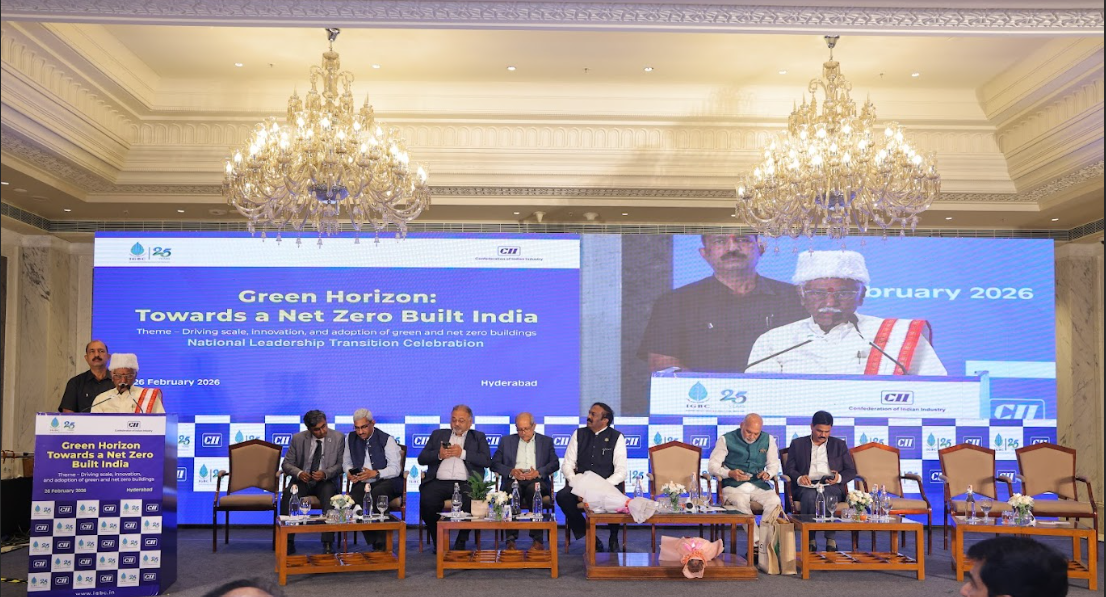
Bringing together a wide spectrum of leaders from the built environment ecosystem, the event underscored the increasing alignment between India’s development priorities and its long-term Net Zero commitment. As India accelerated toward a low-carbon growth trajectory, the discussions highlighted the pivotal role of buildings in driving decarbonization, enhancing resource efficiency, and enabling climate-resilient urbanization.
Over the past 25 years, IGBC has played a transformative role in reshaping how buildings were designed, constructed, and operated across India. Through its 33 holistic rating systems, policy advocacy, and capacity-building initiatives, IGBC has helped move sustainability from a niche practice to a mainstream market driver, enabling businesses and governments alike to align development objectives with environmental performance.
Delivering the IGBC Vision address, C Shekar Reddy, National Chairman, CII Indian Green Building Council, articulated the Council’s strategic direction and long-term roadmap,
“India’s Net Zero journey will be significantly shaped by the pace at which we transform our built environment. Buildings represent one of the most scalable opportunities for carbon reduction, energy efficiency, water stewardship, and occupant well-being. The next phase of India’s sustainability movement must be driven by scale, speed, and systemic integration. IGBC’s Vision 2035 is focused on mainstreaming green and net-zero buildings across Tier 2 and Tier 3 cities, strengthening policy linkages, expanding industry capabilities, and ensuring that sustainability becomes foundational to India’s growth story. Green buildings are no longer an alternative — they are a strategic necessity for India’s development trajectory.”
Addressing the gathering, Shri Bandaru Dattatraya, Former Governor of Haryana & Himachal Pradesh and Former Member of Parliament – Secunderabad, in his special address, congratulated CII Indian Green Building Council on completing 25 years and its role in helming the green building movement in India. He urged IGBC to focus on Green Telangana and ensure that technology plays a central role in the growth of the state.
“Sustainability must remain central to India’s development trajectory. Green and Net Zero buildings are no longer optional ideals but essential instruments of climate action, economic efficiency, and societal well-being. As India advances toward its growth ambitions, the integration of innovation, scale, and widespread adoption of sustainable building practices will be critical. With progressive national commitments and strong institutional leadership, India can build not just resilient infrastructure, but a future defined by responsibility, efficiency, and long-term prosperity.”
Shri CV Anand, IPS, Special Chief Secretary to Government, Home Department, Govt. of Telangana emphasized on the need to focus on sustainable development. He lauded IGBC’s role in stewarding the green building movement when he said,
“Sustainable development is no longer a choice but a necessity for our cities and communities. The Indian Green Building Council has played a commendable role in advancing the green building movement in India. Going forward, it is essential that we continue supporting industry stakeholders so that urban development strategies increasingly align with sustainability goals, ensuring long-term environmental and societal resilience.”
Shri Alla Ayodhya Rami Reddy, Member of Parliament, Rajya Sabha (Andhra Pradesh) and Chairman, Ramky Group said that
“we need to focus on carbon emissions and need to make responsible choices. He further stated that CII IGBC needs to continue to helm the green building and sustainable built movement in India and for the next 25 years IGBC needs to collaborate with the industry and manufacturers and bring in structures, models and systems that everyone can adhere to.”
The event also featured perspectives from senior industry and government leaders who emphasized the increasing convergence between sustainability, competitiveness, and national development priorities. Shri Kishen Reddy, Vice-Chancellor, Jawaharlal Nehru Technical University (JNTU), said,
“India’s economic expansion and urbanization demand a development model that is both growth-oriented and resource-efficient. Sustainability is no longer a peripheral consideration — it is central to long-term competitiveness, resilience, and value creation. IGBC’s leadership has been instrumental in providing industry with credible, structured pathways to adopt green and net-zero practices.”
The event witnessed strong participation from the broader industry ecosystem, with office bearers and representatives from leading associations including NAREDCO, IPA, IIA, IIID, FSAI, TFMC, ITFAN, ISHRAE, ASHRAE, TBF, CREDAI, and HYSEA attending the session. Their presence reflected the widening institutional alignment and cross-sector collaboration necessary to accelerate India’s transition toward green and net-zero buildings.
The deliberations collectively reinforced that as India’s built environment continued to expand at unprecedented speed, sustainability could no longer be viewed as an incremental enhancement but as a structural foundation for development. IGBC’s leadership remained focused on scaling green building adoption across emerging urban centers, strengthening policy advocacy, advancing net-zero frameworks, expanding professional capacity, and driving greater market awareness.
Leave a Reply