



New Delhi, Nov 16: The devastating earthquake that struck Gujarat on January 26, 2001, tested the state’s administrative machinery on an unprecedented scale. With communication networks down, thousands of villages affected and critical infrastructure reduced to rubble, the disaster demanded more than emergency relief. It called for decisive leadership, coordinated governance and a long-term strategy to rebuild lives and livelihoods.
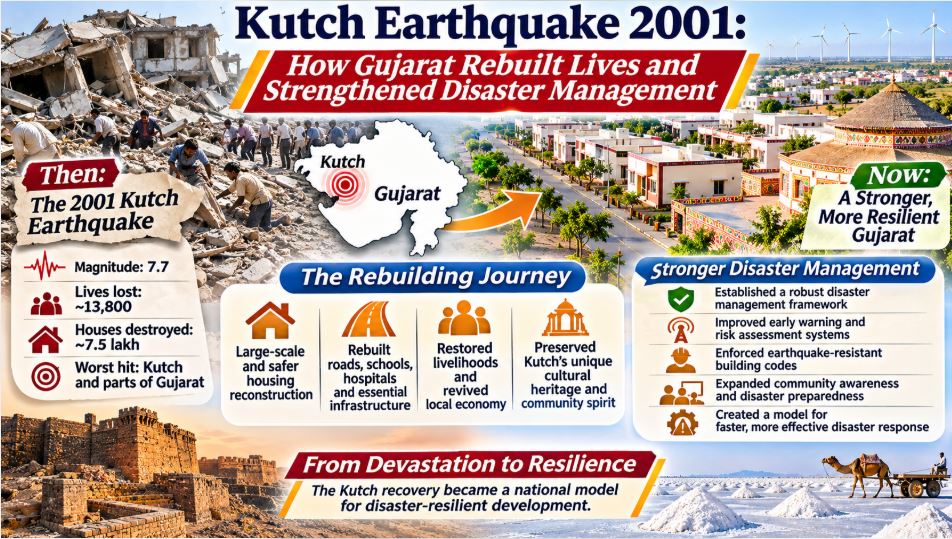
Representational Image
The response that followed became a significant example of disaster recovery driven by institutional reform, community participation and accountability. From the creation of the Gujarat State Disaster Management Authority (GSDMA) within weeks of the earthquake to an owner-driven housing programme that placed families at the centre of reconstruction, Gujarat’s experience helped shape a broader approach to disaster preparedness and resilience.
By January 2004, nearly 1.87 lakh houses had been reconstructed, thousands of schoolrooms and health facilities had been restored, and new systems for disaster management had begun taking shape.
A disaster of unprecedented scale
At 8:46 am on January 26, 2001, an earthquake measuring 6.9 on the Richter scale struck Gujarat, with its epicentre in the Kutch region.
The earthquake affected around 7,633 villages across 181 talukas, impacting nearly one crore people. It claimed 13,805 lives, including 12,221 in Kutch, while approximately 1.67 lakh people were injured.
The destruction extended far beyond human casualties. More than two lakh houses were completely destroyed and around nine lakh suffered damage. Over 10,000 small and medium industrial units suspended operations, while nearly 50,000 artisans lost their livelihoods.
Although Gujarat had preparedness arrangements for cyclones and floods, it lacked a dedicated earthquake response plan. The scale of the devastation therefore exposed serious gaps in disaster preparedness and tested the ability of government institutions to respond under extreme conditions.
Immediate action despite communication breakdown
The state administration began coordinating relief operations on the day of the earthquake. The Director of Relief reached the State Control Room in Gandhinagar, but the response soon faced a major obstacle as landline and mobile networks failed within an hour.
Satellite phones and police wireless systems became crucial communication channels.
In Bhuj, the Superintendent of Police coordinated search-and-rescue operations, while the District Collector took charge of relief supplies. A medical camp was established on open ground within approximately two hours. An Army platoon was deployed following a request to the Brigadier, while police families helped organise a community kitchen.
The Centre also moved swiftly. The National Crisis Management Committee met under the Prime Minister on the same day, and ₹500 crore was sanctioned for immediate relief. Armed forces and paramilitary personnel joined rescue operations, while essential supplies were airlifted to the affected areas.
The early response demonstrated the importance of local decision-making and coordination, even when normal communication systems had collapsed.
GSDMA: Building an institution for long-term recovery
As emergency relief gathered momentum, Gujarat shifted its attention towards rehabilitation and reconstruction.
On February 8, 2001, the state government established the Gujarat State Disaster Management Authority (GSDMA) through a government resolution. Its mandate was to oversee the extensive reconstruction programme and coordinate recovery across affected regions.
The institutional framework drew inspiration from the Orissa State Disaster Management Authority, established after the 1999 super cyclone. The Government of India had recommended that Gujarat adopt a similar model.
Initially registered as a society under the Societies Registration Act, GSDMA later received statutory backing through the Gujarat State Disaster Management Act, 2003.
The Chief Minister headed its Governing Body, which included senior ministers and government officials. An initial framework adopted on February 10, 2001, also emphasised public participation, including the involvement of villagers in decisions concerning the relocation of severely damaged settlements.
At the national level, the Government of India constituted a National Committee on Disaster Management on February 13, 2001, following an all-party meeting convened by the Prime Minister.
Reconstruction funding and a people-led housing model
The scale of reconstruction required substantial financial resources. Joint assessments by the World Bank and the Asian Development Bank estimated the damage at ₹9,909 crore and reconstruction requirements at approximately ₹10,575 crore. The Gujarat government subsequently placed its own estimate at around ₹8,496 crore.
The state government also committed significant resources, meeting approximately 30 per cent of the reconstruction cost—around ₹2,603 crore—from its own funds.
Housing emerged as one of the most urgent priorities. On February 23, 2001, the government announced four assistance packages based on the extent of damage, seismic risk and settlement category. A fifth package was introduced on April 24 for the four worst-affected towns of Bhuj, Bhachau, Anjar and Rapar.
A defining feature of the reconstruction policy was its owner-driven approach. Rather than relying entirely on contractors, families were encouraged to rebuild their own houses with financial assistance, technical guidance and earthquake-resistant designs supplied by the government.
Non-governmental organisations and private partners also participated by adopting villages and supporting house construction through public-private partnerships. Financial assistance was released in stages as construction progressed.
The approach, described as ‘reconstruction plus’ or ‘building back better’, sought not merely to replace damaged houses but to make rebuilt communities safer and more resilient.
Accountability and community participation at the grassroots
The recovery programme introduced a structured system for assessing damage and addressing public grievances.
Buildings were classified on a G1-to-G5 scale, ranging from minor damage to complete destruction or damage beyond repair. A total of 2,051 survey teams, comprising 4,592 personnel, including 1,794 revenue officials, carried out assessments. Communities participated in the process, and families were given the option to seek a fresh survey if they disagreed with the findings.
A multi-level grievance redressal mechanism was established through village and district committees, with District Judges designated as ombudsmen. These officials could receive complaints directly and direct the administration to take corrective action.
By October 2003, the ombudsmen had received 47,156 petitions, of which approximately 99 per cent had been addressed.
At the village level, Gram Navrachna Samitis supervised reconstruction. These committees included the Sarpanch, a woman member, representatives of backward castes and minority communities, the primary school headmaster and a non-governmental organisation representative.
A four-tier administrative structure covering the state, district, taluka and village levels helped coordinate implementation. Additional Collectors were posted in the worst-affected talukas, while GSDMA coordinated and monitored the work carried out by government departments.
Quality control was another priority. Financial assistance was released in instalments after engineers certified construction progress. Around 1,082 material banks supplied cement and other building materials, while nearly 30,000 masons and 6,200 engineers received training.
Independent inspections covered approximately 2.6 lakh houses. Reconstructed homes were registered jointly in the names of husbands and wives, and new construction incorporated earthquake-resistant and cyclone-resistant features.
Leadership review accelerated the reconstruction drive
A review in October 2001 identified several gaps in the recovery effort. Some families were still living in tents, while certain schools and government offices continued to operate from temporary facilities.
Urban reconstruction was moving more slowly than rural recovery because of the additional requirements of plot surveys, road widening, land reallocation and dispute resolution. Water shortages and site-related difficulties also affected some newly developed villages.
The administration took action on issues related to debris clearance, including disciplinary proceedings against 276 government employees and cases involving 738 persons linked to local bodies.
After Narendra Modi assumed office as Chief Minister in October 2001, the government undertook a fresh review of reconstruction progress. Eleven senior Secretaries were assigned to the worst-affected talukas, with each official required to spend three days every weekend in the allotted area until the end of January 2002.
The Secretaries reported to the Chief Minister at review meetings every Monday. The objective was to demonstrate visible progress by the first anniversary of the earthquake on January 26, 2002.
Field visits and regular reviews helped identify bottlenecks, resolve policy and operational issues, and accelerate the pace of rehabilitation.
By 2004, recovery had transformed housing, education and healthcare
The reconstruction programme delivered substantial progress over the following three years.
By January 2002, approximately 7.7 lakh houses had been repaired and nearly 60,000 reconstructed. The number of rebuilt houses increased to around 1.43 lakh by January 2003 and 1.87 lakh by January 2004, representing 87 per cent of the target of approximately 2.15 lakh houses.
Education infrastructure also saw major restoration. By January 2004, all 42,678 primary schoolrooms identified for repair had been repaired. Of the 8,212 destroyed schoolrooms, 7,469 had been reconstructed.
Healthcare facilities received a major boost with the rebuilding of the District Civil Hospital in Bhuj. Constructed at a cost of approximately ₹114 crore with assistance from the Prime Minister’s National Relief Fund, the hospital incorporated base-isolation technology to improve its ability to withstand earthquakes. It was inaugurated on January 14, 2004.
The recovery programme also led to the construction of six community health centres, 24 primary health centres, 184 sub-centres and 183 anganwadi centres.
Town planning and industrial revival
Rebuilding Kutch’s urban centres required a broader approach involving land use, infrastructure and planned development.
Area Development Authorities were established for Bhuj, Anjar, Bhachau and Rapar to prepare town plans and develop new infrastructure. Consulting firms were engaged to prepare development plans, issue building permissions and identify relocation sites.
Urban infrastructure projects included approximately 403 km of roads, 546 km of water pipelines and 504 km of sewerage networks. The programme also covered 134 municipal buildings, around 40 per cent of which had been completed by January 2004.
Economic recovery was pursued alongside physical reconstruction. The Centre and the Gujarat government announced tax incentives for new industrial units in Kutch, including exemptions from excise duty, sales tax and octroi.
By March 2004, 151 new industrial projects with proposed investments of approximately ₹4,785 crore had been located in the region, signalling renewed industrial interest and opportunities for employment.
From earthquake recovery to a lasting disaster management framework
The earthquake also triggered institutional reforms that extended beyond immediate reconstruction.
Gujarat adopted its State Disaster Management Policy in September 2002, followed by the Gujarat State Disaster Management Act in 2003. The Gujarat Institute of Disaster Management was established to strengthen training and institutional capacity among officials and communities.
Village-level preparedness teams, known as Afat Sajjat Senas, were formed in 484 villages. The state also took steps in 2002 to make disaster preparedness a regular agenda item for Gram Sabhas, embedding risk awareness within local governance.
The state’s recovery and disaster management initiatives received international recognition. The United Nations conferred the Sasakawa Award for disaster reduction in 2003, while the Commonwealth Association for Public Administration and Management presented its Gold Award for innovation in governance in 2004.
These developments formed part of the wider evolution of India’s disaster management framework, preceding the enactment of the Disaster Management Act, 2005, which established a national legal framework for disaster management.
Six lessons from Kutch’s recovery
The Kutch experience offers important lessons for disaster response and long-term resilience:
Act quickly, even amid uncertainty: Immediate decisions and clear responsibilities helped initiate rescue and relief despite communication failures.
Create institutions for sustained recovery: GSDMA provided a dedicated structure to coordinate reconstruction and later became a statutory authority.
Put communities at the centre: The owner-driven housing model and village-level participation gave affected families a direct role in rebuilding.
Make accountability accessible: Damage reassessments, grievance committees and district-level ombudsmen gave citizens avenues to seek redress.
Review progress and correct weaknesses: Field inspections and weekly reviews helped address delays and accelerate implementation.
Build preparedness for the future: Policy reforms, legislation, training institutions and village-level teams strengthened Gujarat’s long-term disaster management capacity.
A legacy beyond reconstruction
The 2001 Kutch earthquake remains one of the most devastating disasters in Gujarat’s history. But the recovery that followed demonstrated how timely decisions, institutional coordination, public participation and sustained accountability can turn a major crisis into an opportunity for systemic reform.
The rebuilding of nearly 1.87 lakh houses by January 2004 was a major milestone. Equally significant was the creation of institutions and community-based systems designed to reduce future risks.
Kutch’s experience underlined a central lesson in disaster governance: recovery is not simply about restoring what was lost. It is about rebuilding safer communities, strengthening public institutions and ensuring that people are better prepared for the next crisis.
